A check that never passed
Some of the pages I make are previews for Shopify merchants: one of their own product pages with a PopSmart app placed on it. They are static files on a subdomain of the PopSmart site, and that zone sits behind Cloudflare on the Free plan.
Before a link to one of those pages goes out, a check downloads the page the way a visitor would and compares its SHA-256 hash with the hash recorded when I published it. If the two differ, the link doesn’t go out. What the merchant opens should be exactly what I looked at.
On November 5, 2026, the first time the check ran against the live pages, it failed for all four of them. Nobody had edited them. Left as it was, the check would have stopped every link.
Eighteen bytes
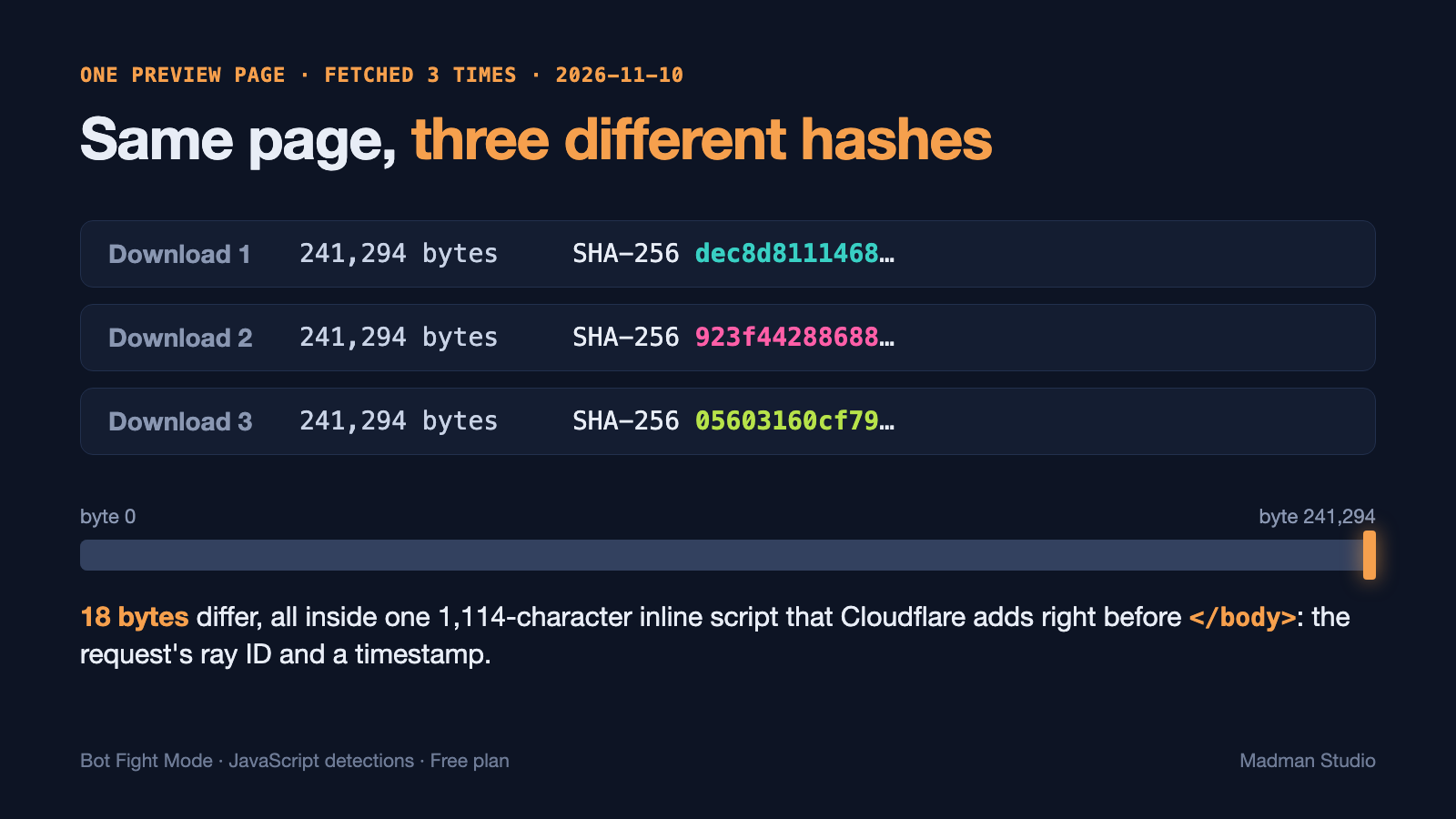
I reproduced it again today, November 10, with one of those preview pages. I downloaded it three times in a row. All three copies were 241,294 bytes long, and all three had a different SHA-256 hash.
The copies differed in 18 bytes. Every one of them sat inside an inline script of 1,114 characters, placed right before the closing </body> tag. The parts that changed were a request ID, which matched the cf-ray header of that same response, and a timestamp. With that script cut out, the three copies were identical.
Trimmed, with the IDs replaced, the interesting part looks like this:
window.__CF$cv$params={r:'RAY_ID',t:'TIMESTAMP'};
// then loads /cdn-cgi/challenge-platform/scripts/jsd/main.js?ray=RAY_ID
Where the script comes from
The /cdn-cgi/challenge-platform/ path belongs to Cloudflare’s JavaScript detections, a script that runs in the visitor’s browser to help tell people from bots. Cloudflare’s documentation page for it says the tag is inserted into the HTML pages of the site, and one line there settled the question for me: “For Bot Fight Mode customers, JavaScript Detections is automatically enabled and cannot be disabled.”
The zone is on the Free plan with Bot Fight Mode on. When I looked on November 9, there was no setting to leave the script out for one host or one path. The only switch was Bot Fight Mode itself, for the whole zone, which also covers the main site. The same page says JavaScript detections are optional with Super Bot Fight Mode, which comes with the paid plans.
On these particular pages the script doesn’t even run. They set a Content Security Policy that only allows scripts from the page’s own origin, so the browser refuses the inline script and logs one console error. The bytes are still in the response, though, and the hash sees them.
What I changed
I left Bot Fight Mode on and made the check aware of this one script. When the first hash doesn’t match, it looks for the script in one exact place and compares again without it:
1. hash the page as served; if it matches what I published, pass
2. if the last thing before the final </body> is Cloudflare's detection script,
   with the exact expected text apart from the ray ID (the same value in both
   places) and the timestamp, cut out exactly those bytes and hash again
3. if that matches, pass; anything else, block
Any other difference still fails. That includes a changed version of Cloudflare’s own script: if they edit a single character of it, links stop until I update the expected text. I prefer that to a check that quietly accepts changes it doesn’t recognize.
After the change, all four live pages matched byte for byte.
What I haven’t tested
The same documentation page says Cloudflare does not inject the script when the origin sends a no-transform cache-control header. These pages are static files, so that could leave them untouched on the way out. I haven’t tried it on this host yet.
It also says ETags are stripped from HTML responses where the script is injected, which matters if anything you run depends on them.
If you compare served HTML with a stored hash on a Free-plan zone with Bot Fight Mode on, expect the comparison to fail until it accounts for this script.