
-
 PHOTO
Claude Startups Approved Twitter
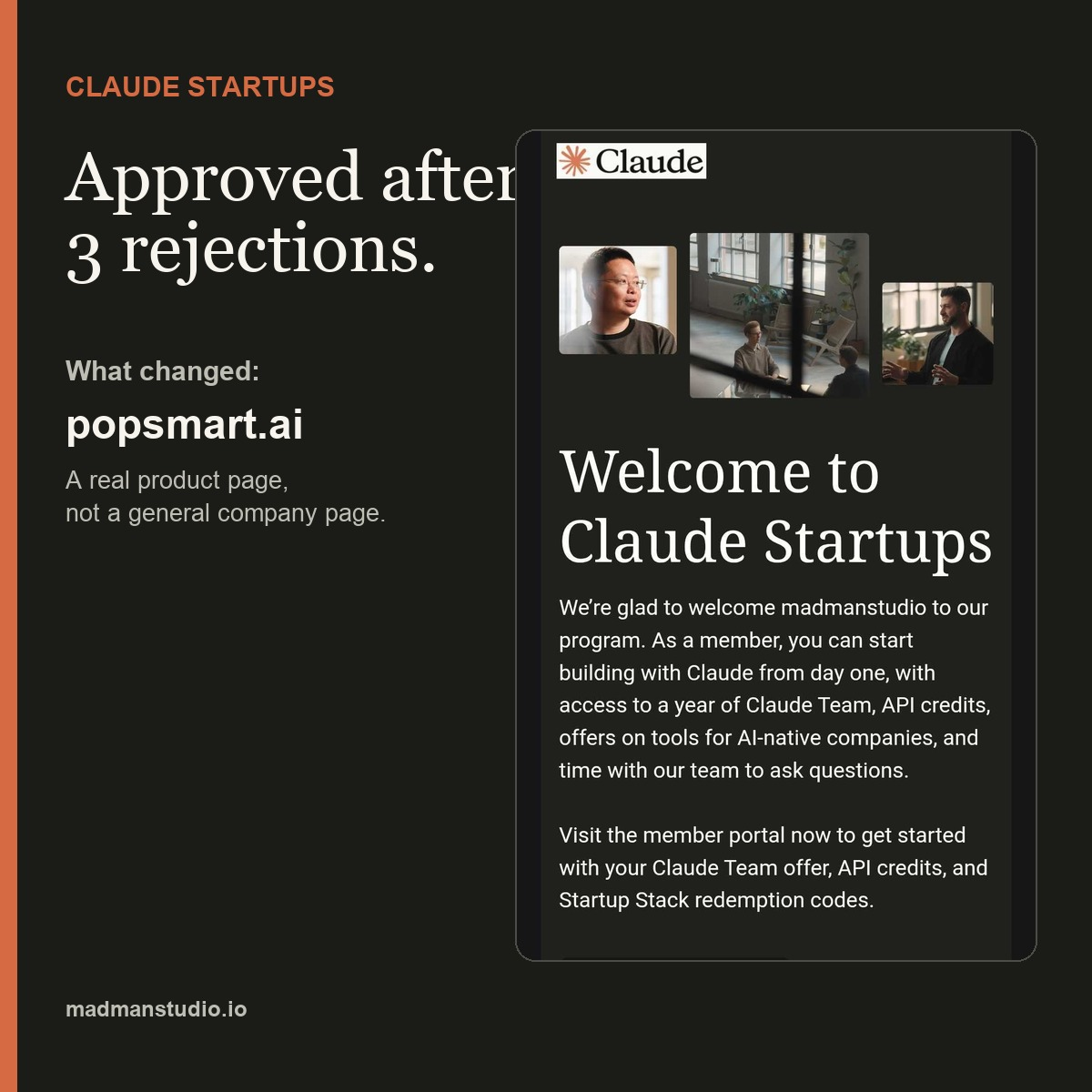
Claude Startups acceptance message with the note Approved after 3 rejections and What changed: popsmart.ai.
-
 PHOTO
Claude Startups Approved Threads
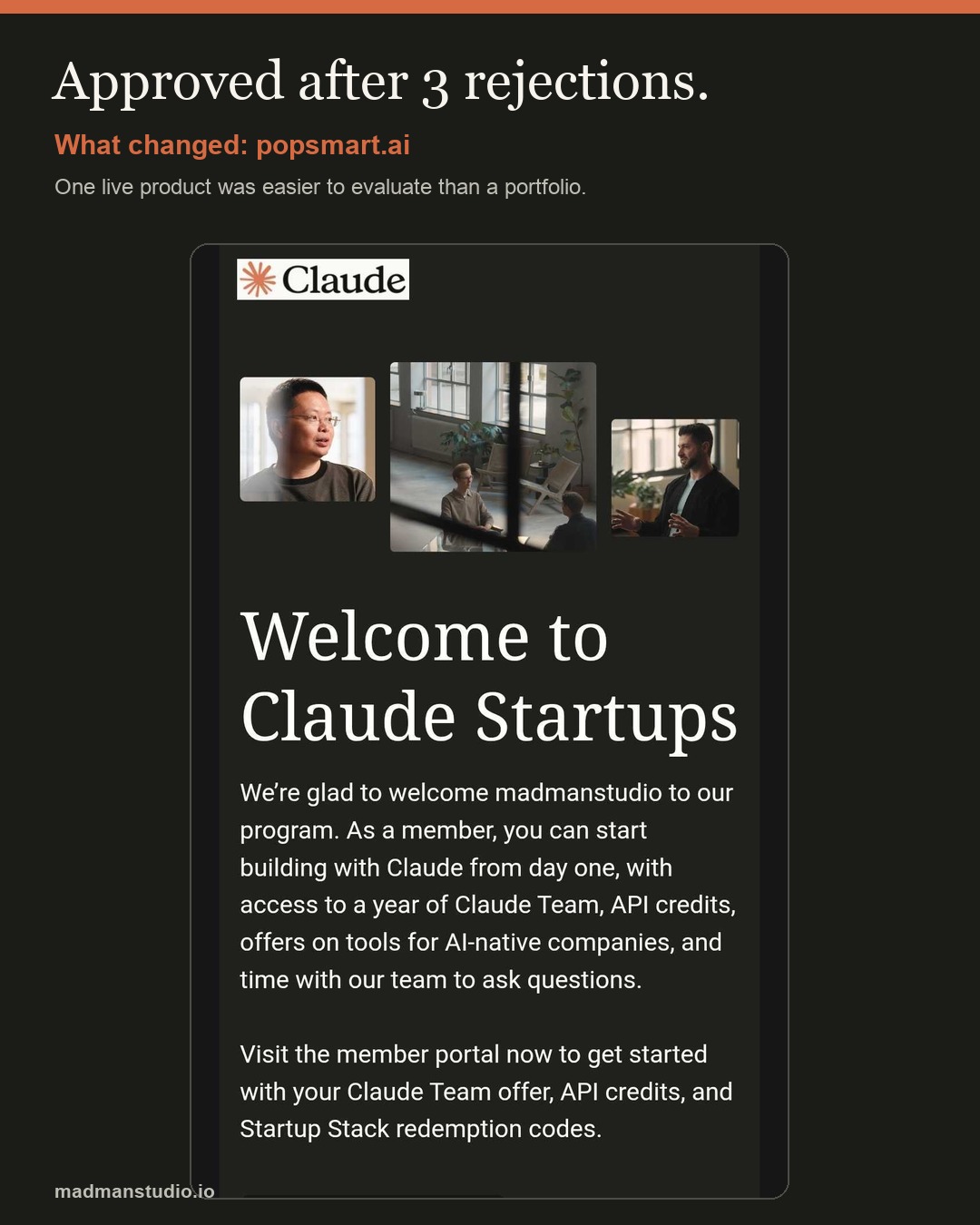
Claude Startups acceptance message with the note Approved after 3 rejections and What changed: popsmart.ai.
-
 PHOTO
Claude Startups Approved Linkedin
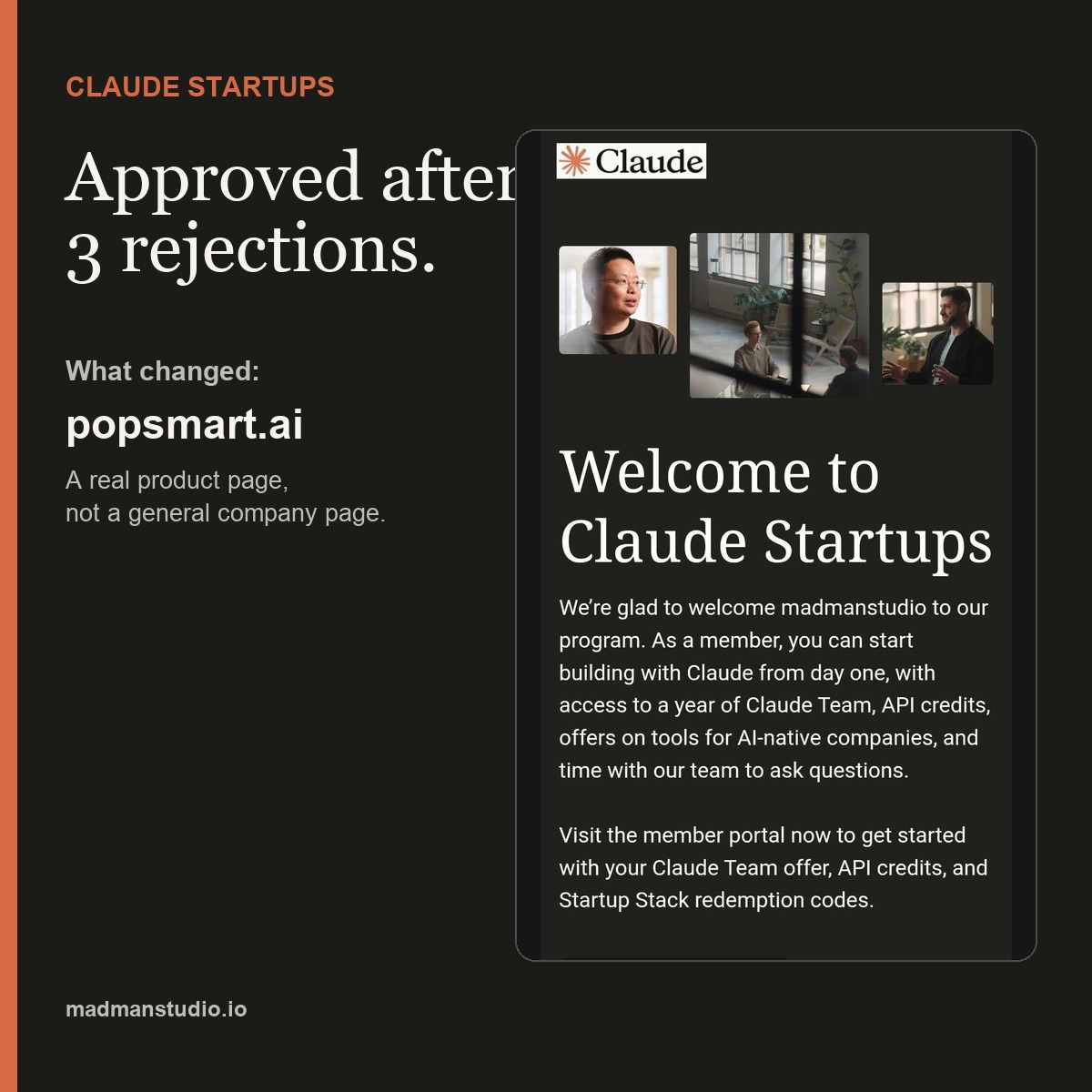
Claude Startups acceptance message with the note Approved after 3 rejections and What changed: popsmart.ai.
Yesterday I published a note called I Applied to Claude Startups Three Times. Three Rejections, No Diagnosis.
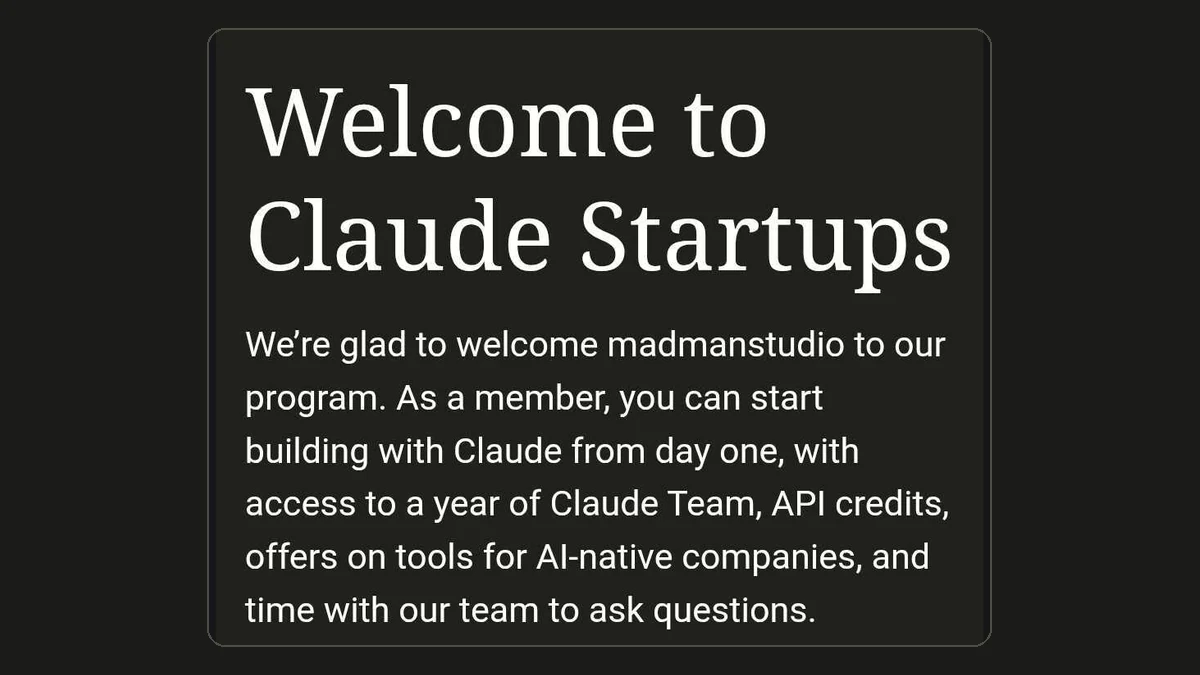
Today I need to update it: Claude Startups approved the new application.
The change was not another rewrite of the same company story. I created a new Anthropic account around popsmart.ai and linked the application directly to the live PopSmart service landing page instead of the broader company page.
That application was approved on its first try.
What was different
The first three applications were submitted in a company context. The company page was real, but it represented a studio with several products, notes, and experiments. A reviewer had to move from the company to the portfolio, decide which product mattered, and infer what I planned to build with Claude.
For the new application, I reduced that interpretation work.
I used one operating service: PopSmart. I created a separate Anthropic account around that service and linked the page where the product actually lives. The application no longer asked a reviewer to understand the whole studio before understanding the use case.
The sequence was simple:
- Three applications built around the general company context were rejected.
- I created a new Anthropic account around
popsmart.ai. - I linked the live service landing page in the application.
- The new application was approved on its first attempt.
That sequence is factual. The explanation still requires care.
I cannot prove why it worked
Anthropic did not send a comparison explaining why this application passed while the other three failed. I do not know whether the deciding factor was the domain, the account, the product page, the wording, or some combination of them.
So I am not turning this into a guaranteed approval trick.
What I can say is that the account and product presentation were the material changes. The earlier applications described a company. The approved application showed one live product and the page where it could be evaluated.
That is a useful difference even if it is not a formal rule.
What I would tell another founder
If you are applying to Claude Startups, make the application easy to inspect.
Use the identity of the product you are actually building. Use a domain and email that clearly belong together. Link the live landing page, not a general portfolio if the portfolio forces the reviewer to hunt for the relevant service. Make the page answer a few basic questions without requiring a call:
- What does the product do?
- Who is it for?
- Is it operating now or still an idea?
- Where does Claude fit into the product or workflow?
A company page can be accurate and still be too broad. A product landing page can make the same business easier to understand because it reduces the number of decisions the reviewer has to make.
The lesson is not to invent a cleaner story than the product deserves. The lesson is to point the application at the clearest available evidence.
The update to yesterday’s conclusion
Yesterday I wrote that three rejections were a result, but without a reason they were not yet a lesson.
The approval does not fully explain the rejections. It does give me a working hypothesis: the applications were easier to reject when the product was hidden behind the studio, and easier to approve when the product was the application.
That is enough to change what I would do next time.
I would not lead with the company. I would lead with the live service, the matching domain, and the exact page where the use case can be checked.
One real product was easier to evaluate than a portfolio.